A trailer can look fine from the driver’s seat while quietly chewing through expensive rubber. So, why do trailer tyres scrub? In simple terms, the tyres are being forced to travel slightly sideways instead of rolling straight ahead. That sideways drag creates heat, tears at the tread and can wear a tyre down far quicker than normal highway use.
For owner-drivers, fleet managers and operators hauling equipment around the Hunter, tyre scrub is more than a maintenance nuisance. It can lead to a roadside failure, delayed load, damaged suspension components and avoidable tyre costs. The good news is that the wear pattern usually gives a clear clue about where to start looking.
Why Do Trailer Tyres Scrub?
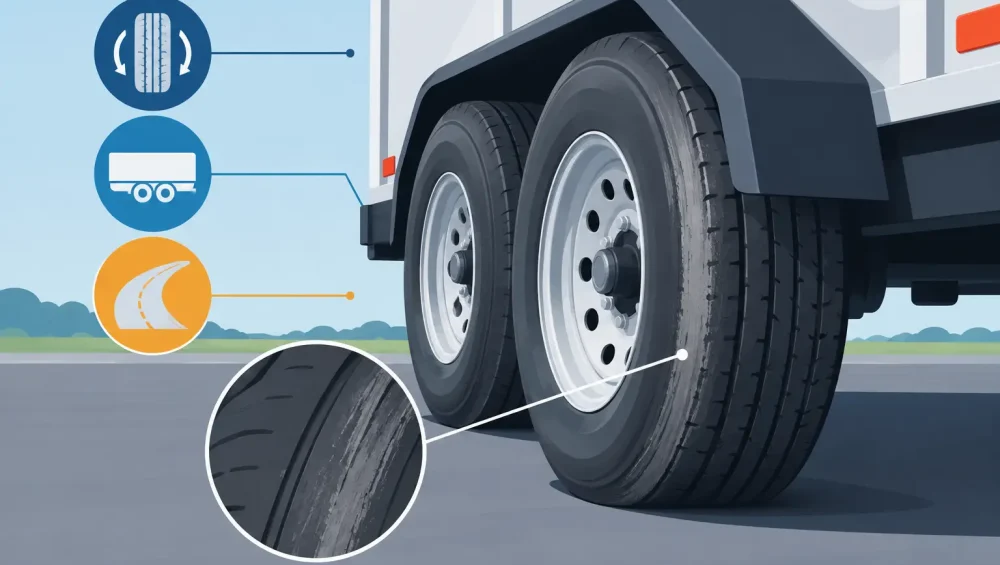
Tyre scrub occurs when the wheel is not pointing or tracking in the same direction as the trailer’s path. As the trailer moves forward, the tyre has to slide across the road surface a small amount on every rotation. A slight misalignment may not be obvious at low speed, but over hundreds of kilometres it can strip rubber from one edge of the tread.
On multi-axle trailers, a small amount of scrub during tight turns is normal. The axles are fixed in place and cannot steer, so the tyres need to slip slightly to let the trailer follow the turn. That is why sharp manoeuvres in yards, loading areas and tight driveways can leave marks on the ground.
What is not normal is rapid, uneven wear during regular straight-line running. If one tyre is going bald on the inside or outside shoulder, has a feathered tread, or looks noticeably different from the tyre on the opposite side, the trailer needs attention before the damage gets worse.
The Most Common Causes of Trailer Tyre Scrub
Axle alignment is out
Incorrect axle alignment is one of the biggest causes of trailer tyre scrub. If an axle is not square to the trailer chassis, the wheels can toe in, toe out or track sideways. This commonly happens after striking a kerb, pothole or road debris, or after a heavy impact when working around rough sites.
A bent axle beam can create the same problem. It does not always take a major crash either. Repeated overloading, harsh corrugated roads and hard kerb strikes can gradually affect alignment. The result is often shoulder wear on one or more tyres, with the trailer seeming to crab down the road rather than tracking cleanly behind the prime mover or tow vehicle.
Worn suspension bushes, hangers or equaliser components
Leaf-spring and mechanical suspension systems rely on bushes, pins, hangers and equaliser components to hold each axle where it belongs. When those parts wear, the axle can shift under load. It may sit correctly while parked, then move out of position as the trailer brakes, turns or carries a full load.
Look for cracked bushes, loose U-bolts, worn suspension pivots, broken springs and damaged hangers. These faults can be easy to overlook during a quick pre-start check, but they allow movement that creates serious tyre wear over time. With air suspension, worn control arm bushes, damaged mounts or incorrect ride height can cause similar tracking issues.
Uneven loading or overloading
A trailer loaded heavier on one side puts more force through those tyres and suspension components. The overloaded side runs hotter and flexes more, increasing wear. If the load is also positioned too far forward, back or high, it can change how the axles share weight and make the trailer less stable.
Overloading is especially hard on tandem and tri-axle trailers. Even when the tyres look adequately inflated, they may be carrying more weight than their rating allows. That extra deflection can worsen scrub and substantially raise the risk of heat-related tyre failure.
Incorrect tyre pressures
Low pressure does not usually cause alignment scrub by itself, but it makes the effects far worse. An underinflated tyre flexes excessively, runs hot and wears rapidly across the shoulders. If an axle is already out of alignment, the softer tyre carcass is more easily dragged sideways.
Overinflation has a different wear pattern, often concentrated through the centre of the tread, but it can reduce the tyre’s ability to absorb impacts. The right pressure depends on tyre size, construction, axle load and operating conditions. Guessing by appearance is not enough on heavy trailers. Use a reliable gauge and set cold pressures to suit the tyre manufacturer’s load-and-pressure guidance.
Mixed tyre sizes or uneven tread depths
Tyres on the same axle should be closely matched in size, construction and rolling circumference. A noticeably different tyre diameter means one tyre rotates at a different rate from the other. On a multi-axle setup, mismatched tyres can fight each other and increase scrub, particularly on hard surfaces and during turns.
It is also worth checking dual assemblies. Incorrectly matched duals do not share the load properly, causing one tyre to work harder than the other. Replacing only one tyre can sometimes be necessary after damage, but it should be done with attention to the remaining tyre’s size, wear and compatibility.
Brake drag or wheel-end faults
A sticking brake can create heat and leave a scuffed or worn-looking tyre, although it is not the same as an alignment problem. If one wheel is much hotter than the others after a run, or the trailer pulls, investigate the brakes promptly. A seized caliper, faulty brake chamber, contaminated components or incorrectly adjusted brakes can all contribute.
Wheel bearing play can also let a wheel run out of true. Any rumbling, vibration, grease leakage or movement at the wheel needs immediate inspection. A tyre cannot wear evenly if the wheel assembly is loose or damaged.
Read the Wear Pattern Before Replacing the Tyre
Replacing a scrubbed tyre without finding the cause is money wasted. A new tyre fitted to a misaligned axle will often start showing the same pattern within a short distance.
Outside shoulder wear can point to axle alignment issues, overloaded corners or suspension movement. Inner shoulder wear may indicate a bent axle, camber problem or faulty suspension geometry. Feathering, where one edge of each tread block feels sharp and the other feels smooth, is a strong sign that the tyre is being dragged sideways. Cupping or scalloped wear can suggest wheel imbalance, suspension wear, loose bearings or repeated bouncing.
Compare every tyre across the trailer, not just the worst one. Check the inside and outside shoulders, run your hand carefully across the tread and note whether wear is isolated to one wheel, one axle or one side. That comparison helps identify whether the fault is local or affects the whole trailer.
What to Do When You Notice Tyre Scrub
Start by taking the trailer out of heavy service if cords are visible, the tyre has deep irregular wear, bulges, cuts or abnormal heat. Continuing to run a damaged tyre can turn an alignment issue into a blowout, particularly with a loaded trailer on the highway.
Next, check pressures cold and inspect the tyres for matching size, load rating and tread condition. Then inspect the suspension and wheel ends for obvious movement, broken parts, loose fasteners or leaking hubs. If there has been a recent kerb strike, pothole impact or overload event, treat that as a likely trigger even if the trailer still seems to tow normally.
A proper alignment assessment is the key next step. This should include measuring axle position relative to the chassis and drawbar, checking toe and camber, and inspecting suspension wear. On heavy trailers, alignment correction may involve axle adjustment, suspension repairs or replacement of a bent axle component. Tyre balancing and rotation can help extend service life once the underlying fault is fixed, but they cannot correct a tracking problem.
Reduce Scrub Before It Starts
Prevention comes down to regular checks and sensible operation. Keep tyre pressures checked, load the trailer evenly, avoid sharp turns on abrasive hardstand where possible and inspect suspension components as part of scheduled maintenance. Drivers should report a trailer that feels like it is pulling, bouncing, sitting unevenly or leaving unusual marks during tight manoeuvres.
For fleets, recording tyre positions, pressures, tread depths and replacement dates makes trends easier to spot. If the same axle keeps wearing tyres, there is almost certainly a mechanical or alignment issue to address rather than a tyre-brand problem.
When a trailer is wearing tyres faster than it should, acting early protects far more than rubber. Hunter Mobile Truck Tyres can assess tyre condition on site and help get the right repair plan moving, so your trailer can get back to tracking straight and earning its keep.