A truck tyre does not start cupping for no reason. Those repeating high and low patches across the tread are a warning that something is not working as it should – and leaving it alone can mean vibration, poor road feel, faster tyre replacement and an unexpected breakdown when you are trying to make a delivery.
Tyre cupping causes are often linked to wheel-end condition, suspension movement, inflation pressure or an imbalance in the tyre and wheel assembly. For owner-drivers, tippers, trailers and long-haul fleets, finding the cause early is the practical way to protect tyres, fuel use and uptime.
What tyre cupping looks and feels like
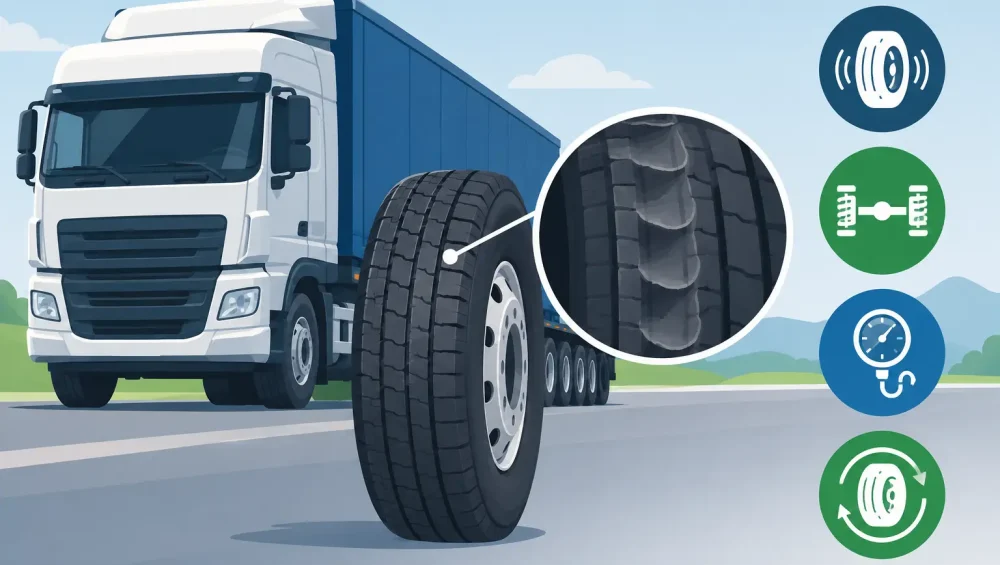
Cupping, also called scalloping, is uneven tread wear that appears as a series of dips or scooped-out sections around the tyre. Rather than wearing evenly across the tread, the tyre develops alternating raised and worn patches. Run your hand carefully across the tread and the surface may feel wavy or stepped.
On the road, a cupped tyre can create a rhythmic humming, droning or thumping sound that gets louder with speed. Drivers may also notice vibration through the steering wheel, cab floor or trailer. On a heavy vehicle, it is easy to put these symptoms down to rough roads or a loaded run. That can be a costly assumption.
Once the tread has cupped badly, correcting the underlying mechanical issue will not restore the damaged rubber. The tyre may still be safe to use only if it is inspected and assessed as suitable, but severe or irregular wear often means replacement is the sensible option.
The main tyre cupping causes on heavy vehicles
Worn shocks, suspension bushes or loose components
Suspension has one major job beyond carrying the load: it keeps the tyre in controlled contact with the road. When shock absorbers are weak, bushes are worn or suspension components have excessive movement, the wheel can bounce rather than track smoothly. Each bounce changes the force placed on the tread, creating the familiar cupped pattern.
This is especially relevant for trucks, trailers and tippers working over uneven sites, unsealed access roads, potholes and corrugations. Heavy loads can expose a suspension issue faster, but an unloaded vehicle can cup tyres too. The key issue is uncontrolled wheel movement, not simply the kilometres travelled.
Wheel and tyre imbalance
An out-of-balance tyre and wheel assembly rotates with more force on one section than another. At highway speed, that small imbalance can become a constant vibration. Over time, it pounds the tread against the road and can contribute to irregular wear.
Balancing is sometimes skipped on heavy commercial applications because the tyre looks sound or the vehicle is still driving straight. That is a false economy. Proper wheel balancing helps tyres wear more evenly and can reduce the vibration that stresses steering, suspension and wheel-end components.
Incorrect tyre pressure
Pressure has a direct impact on tread contact, heat and load carrying. Under-inflated tyres flex excessively and run hot. Over-inflated tyres have a smaller contact patch and can become more vulnerable to impact damage and irregular wear. Either condition can worsen cupping where another fault already exists.
There is no single pressure that suits every truck or trailer. The correct setting depends on tyre size, axle position, tyre manufacturer guidance and the load being carried. A vehicle that changes between empty and fully loaded work may need a pressure-management routine that accounts for those conditions.
Wheel alignment problems
Alignment issues more commonly cause feathering, shoulder wear or rapid wear on one side of the tread, but they can work alongside other faults to make cupping worse. Incorrect toe, camber or caster changes how the tyre meets the road. If a tyre is already bouncing due to a worn shock or suspension issue, poor alignment can accelerate the damage.
A steering pull, an off-centre steering wheel or tyres wearing faster on one edge should be checked before the tread becomes unusable. Do not assume that fitting new tyres alone fixes the problem. New rubber fitted to a misaligned axle will often develop the same wear pattern.
Damaged rims, bearings or wheel-end faults
A bent rim, loose wheel bearing, worn kingpins or other wheel-end wear can allow the tyre to run out of true. The result may feel similar to an imbalance, but the fix is different. If the wheel assembly has excessive play or does not rotate correctly, balancing alone will not solve it.
This is why a proper inspection matters. The visible tread tells part of the story, while the tyre, rim, hub and suspension need to be checked together. Replacing a cupped tyre without locating the fault can put you back in the same position a few weeks or months later.
Road conditions and impact damage
Hunter region operators know that road conditions vary sharply between highways, industrial estates, quarry access roads and rural job sites. Potholes, sharp edges, washouts and repeated rough-road work can damage tyres, wheels and suspension components in one hit or slowly over time.
Road conditions alone do not always cause cupping. More often, they expose a weakness in the suspension, wheel balance or inflation setup. After a hard impact, inspect the tyre for sidewall damage, bulges, cuts and tread irregularities rather than waiting for the next scheduled service.
Why ignoring cupping costs more than one tyre
Cupped tyres are noisy, uncomfortable and less predictable, particularly in wet conditions or during braking. The vibration they create can also place extra strain on shocks, bearings, steering parts and trailer components. For a fleet, that turns one tyre issue into repeat maintenance and avoidable downtime.
There is also a fuel cost. Tyres that do not roll evenly can increase rolling resistance, while incorrect pressures add further drag. The exact impact depends on the vehicle, route and load, but on regular long-haul work, small losses add up quickly.
Most importantly, uneven wear needs attention before it becomes a roadside problem. A tyre with deep cups, exposed wear indicators, structural damage or severe vibration should not be treated as a “finish the shift” issue. Pull up safely and arrange an inspection.
How to prevent tyre cupping before it stops the job
Prevention is not complicated, but it must be consistent. Start with regular visual tread checks and pressure checks when tyres are cold. Look for scalloping, shoulder wear, cuts, embedded objects and changes between tyres on the same axle.
Keep wheel balancing, alignment and rotation within the vehicle manufacturer and tyre supplier recommendations. Rotation can help spread wear across suitable tyre positions, but it is not a cure for a mechanical defect. If one tyre is cupping, inspect shocks, bushes, bearings, rims and steering or suspension components before rotating it elsewhere.
For fleet operators, record tyre pressures, tread depth, repairs and replacement positions. A simple maintenance record can reveal whether a particular axle, route or vehicle is repeatedly causing uneven wear. That information makes it easier to schedule repairs before a truck or trailer is stranded.
Drivers are often the first to notice the change. A new vibration, humming noise or steering shake should be reported early, even if the vehicle is still running normally. Quick reporting gives the workshop or mobile tyre technician a better chance of saving the tyre and avoiding a missed run.
When to get a mobile tyre inspection
If cupping is visible, vibration is increasing or a tyre has taken a hard knock, arrange an assessment as soon as practical. The right response depends on the condition of the tyre. Some vehicles need pressure correction, balancing or rotation. Others need a tyre replacement and mechanical repair before returning to service.
For trucks, trailers and fleet vehicles across the Hunter region, Hunter Mobile Truck Tyres can attend on-site to inspect tyre condition, provide replacement options and help keep your vehicle moving without the time lost travelling to a tyre workshop. If the issue is mechanical, the tyre findings can also give your repairer a clear starting point.
A tyre should wear its tread, not wear out the rest of the vehicle. Act on the first signs of cupping, fix the reason behind it and you will give every kilometre a better chance of being productive.