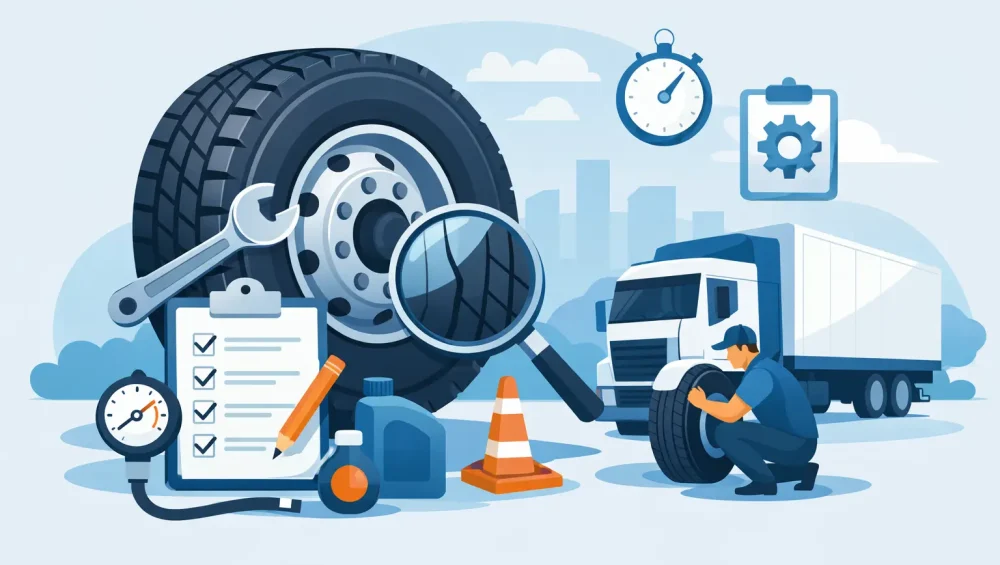
A tyre issue rarely gives a truck operator a convenient warning. It shows up when you are loaded, on a deadline, miles from the depot or parked at a job site. This truck tyre maintenance checklist gives drivers and fleet managers a practical routine for finding problems early, protecting tyre life and keeping heavy vehicles on the road.
Tyres carry the load, transfer braking force and take the punishment from rough shoulders, kerbs, potholes and long highway kilometres. A quick check before a run can be the difference between a planned repair and a costly roadside blowout.
Truck tyre maintenance checklist: start before every shift
A pre-start walk-around should be part of every driver’s routine. It does not need to take long, but it needs to be done properly. Walk around the truck, trailer and any dolly in good light where possible. Look at both sides of every tyre, not only the outer sidewall you can see first.
Use this daily check to catch the common causes of tyre downtime:
- Check tyre pressures when tyres are cold and set them to the pressure specified for the vehicle, axle position and operating load.
- Look for cuts, bulges, exposed cords, deep cracking, punctures, embedded stones, nails and loose objects.
- Inspect tread depth and wear across the full tread face, watching for one-sided wear, scalloping or smooth patches.
- Check dual tyres for debris trapped between them, uneven diameter, contact marks and adequate clearance.
- Look over wheels, rims, valve caps and wheel nuts for cracks, damage, leaks, missing components or signs of movement.
- Listen for air leaks and take notice of any vibration, pull, thump or steering change reported during the previous run.
Do not treat a suspect tyre as something to monitor for another week. A bulge, exposed steel belt, serious sidewall damage or a tyre that keeps losing pressure needs immediate attention. The risk is not worth the lost time, vehicle damage or safety consequences.
Get tyre pressure right for the actual job
Incorrect pressure is one of the fastest ways to wear out a truck tyre early. Underinflation creates excess heat and flexing, especially when a truck is loaded or travelling at highway speed. It can lead to shoulder wear, casing damage, poor fuel economy and eventual failure. Overinflation can reduce the contact patch, encourage centre tread wear and make the ride harsher over rough ground.
There is no one pressure that suits every truck. A prime mover doing long-haul work, a tipper working between quarry sites and a trailer carrying changing loads may need different pressures. Follow the tyre manufacturer and vehicle recommendations for the axle load and tyre size being used. When loads vary, fleet managers should set a clear pressure procedure rather than expecting drivers to guess.
Always use a reliable gauge. Visual checks matter, but they cannot confirm pressure accurately. Check tyres cold, ideally before the vehicle has been driven or after it has been parked long enough to cool. Never bleed a hot tyre simply because its pressure has risen during operation. Heat increases pressure naturally, and reducing it while hot can leave the tyre dangerously underinflated once it cools.
Read the wear pattern before it becomes a replacement bill
Uneven tread wear tells you that something else may need attention. Replacing the tyre without fixing the cause usually means the new tyre will wear the same way.
Wear concentrated on both shoulders often points to underinflation. Centre wear can indicate overinflation. Wear on one edge may be linked to alignment, suspension wear, incorrect camber or a bent component. Cupping and scalloping can be caused by worn shocks, balance problems or loose steering and suspension parts. Feathering can also indicate an alignment issue.
Trailer tyres deserve the same attention as drive and steer tyres. They can scrub away quickly when an axle is misaligned, particularly on tight turns, uneven surfaces and heavily loaded work. If one tyre is wearing faster than the rest, have the vehicle assessed before fitting a replacement.
Record what you find. A basic fleet tyre record should show pressure checks, tread readings, puncture repairs, tyre position, rotations and replacement dates. Those notes make repeat problems easier to identify and help you budget for tyres before they become an emergency expense.
Check damage properly, not just tread depth
A tyre can have plenty of tread left and still be unsafe. Sidewalls are particularly vulnerable to impact damage from kerbs, rocks, potholes and site hazards. A raised bubble can mean internal cord damage. Deep cuts, splits or visible cords require prompt professional inspection and, in many cases, replacement.
Remove stones lodged in the tread where it is safe to do so, but do not pull out a nail or screw if the tyre is holding air. Mark the location and arrange a repair assessment. Removing the object can turn a slow leak into a flat tyre before help arrives.
For dual assemblies, check the gap between tyres every day. A stone, timber offcut or other debris caught between them can rapidly damage both casings. Dual tyres should also be closely matched in size and inflation. Significant differences can overload one tyre and create heat that shortens its service life.
Rotate and balance tyres when the wear calls for it
Rotation helps spread wear across suitable axle positions, but it is not a set-and-forget task. The correct rotation pattern depends on tyre type, tread design, axle position and vehicle application. Steer, drive and trailer tyres do different work, so moving a tyre only makes sense when it is approved for that position and likely to improve overall tyre life.
Wheel balancing is often overlooked on heavy vehicles until vibration becomes obvious. Correct balancing can help reduce irregular wear and improve driver comfort, particularly on steer tyres. If a driver notices a shake through the steering wheel, a repeated vibration at speed or unusual tread wear, book an inspection rather than waiting for the next scheduled service.
Alignment should also be checked after a serious pothole strike, kerb impact, suspension repair or repeated uneven wear. It is cheaper to correct alignment early than to sacrifice a set of tyres.
Match the tyre to the work you actually do
The cheapest tyre is not always the lowest-cost option. A tyre that is right for long-haul highway work may not suit frequent quarry access, muddy farm tracks or stop-start metropolitan deliveries. Load rating, tread pattern, casing quality and expected kilometres all matter.
For some operators, premium new tyres offer the best long-term value through durability and casing potential. For others, a quality used truck tyre may be a sensible short-term solution for a spare wheel, low-kilometre application or urgent replacement. The decision depends on the vehicle’s job, load, road conditions and how long the tyre needs to remain in service.
Do not mix incompatible tyres across an axle just because one is available. Differences in size, construction or wear can affect handling and increase stress on the assembly. When a replacement is needed, get advice based on the truck or trailer, axle position and work conditions.
Give drivers a clear defect reporting process
Drivers are often the first people to see a problem, but a defect report only helps if it leads to action. Make it easy to report pressure loss, damage, vibration and unusual wear as soon as it is found. A photo, tyre position and brief description can save time when arranging a repair or mobile callout.
For fleet operators, decide in advance who can approve repairs and replacements after hours. Tyre failures do not wait for business hours, and delayed decisions can leave a loaded truck parked longer than necessary. Keep tyre sizes, preferred brands, fleet details and service contacts available to drivers.
When a tyre problem stops your vehicle in the Hunter, Newcastle or on a regional run, Hunter Mobile Truck Tyres can come to the roadside, depot or work site with practical support for punctures, replacements, fitting and fleet tyre needs. Fast action can limit the disruption, but regular inspections are what prevent many callouts in the first place.
Know when to park it and call for help
Do not continue driving on a flat or seriously damaged tyre in the hope of reaching the next workshop. Driving on an underinflated tyre can destroy the casing, damage the wheel and turn a repairable issue into a larger replacement job. It can also place other road users at risk.
Park safely where possible, use the required warning measures and give the service technician clear location details, including the road, direction of travel, nearest landmark and tyre position. If you are carrying a load, mention the type of load and access conditions at the site. That helps the right equipment and replacement tyre arrive sooner.
A disciplined tyre routine is not paperwork for its own sake. It is a practical way to protect your driver, your load, your schedule and your bottom line. Make the checks part of the shift, act on defects early, and get experienced help before a small issue becomes a truck off the road.