A loaded truck that starts shaking through the steering wheel at highway speed is not just uncomfortable. It can wear tyres faster, fatigue the driver and turn a manageable maintenance job into unplanned downtime. Knowing when tyres need balancing helps owner-drivers and fleet managers act before vibration starts costing serious money.
For trucks, tippers, trailers and long-haul vehicles, wheel balance is about keeping the tyre and wheel assembly rotating evenly. A small weight difference around the wheel can become a noticeable force once the vehicle is travelling at speed. The result may be a steering shake, vibration through the cab, irregular tread wear or a rough ride that gets worse on faster roads.
What tyre balancing does for heavy vehicles
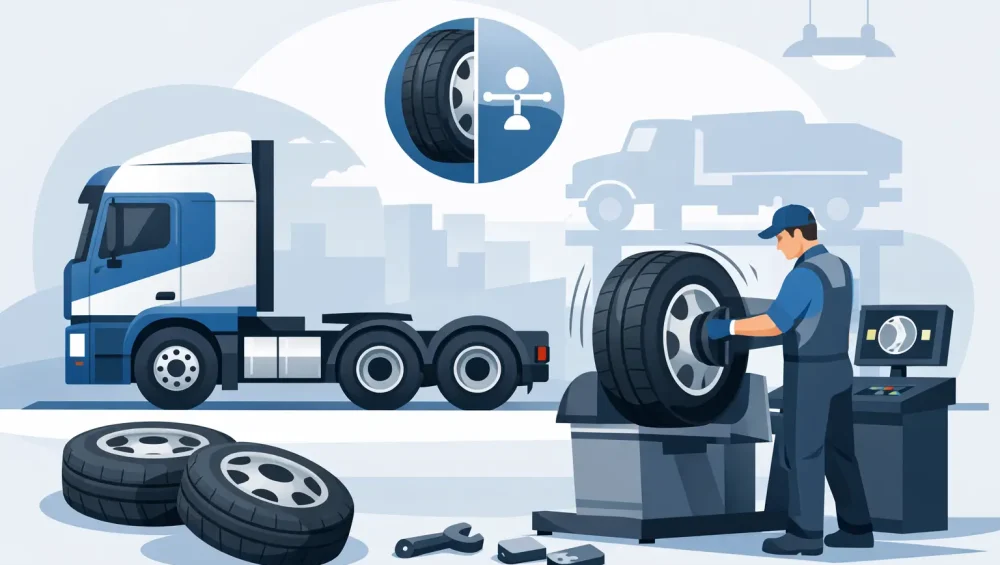
Tyre balancing corrects uneven weight distribution in a wheel and tyre assembly. A technician uses balancing equipment to identify the heavy and light points, then fits the correct counterweights so the assembly rotates as evenly as possible.
On a passenger vehicle, an out-of-balance wheel often shows up as a vibration at a particular speed. Heavy vehicles can show the same symptom, but the consequences can spread further. Steering components, suspension parts, bearings and tyres all deal with repeated vibration. On a truck carrying a load day after day, that extra stress is not something to ignore.
Balance is not the same as wheel alignment. Alignment concerns the angles at which tyres meet the road. Balancing concerns the weight distribution of the wheel assembly. Both affect tyre life and handling, and a vehicle can need one, the other or both. Getting the diagnosis right matters because fitting weights will not fix worn suspension, a bent rim, tyre run-out or an alignment issue.
Signs tyres need balancing
The clearest sign is a vibration that appears or becomes stronger at certain road speeds. It may be felt through the steering wheel on a steer axle, through the seat or cab floor, or in the trailer depending on where the affected wheel is fitted.
Watch for these practical warning signs:
- A steering wheel shake that starts at highway speed and reduces again when speed changes.
- A vibration through the cabin, seat or floor that was not there before a tyre repair or replacement.
- Scalloped, cupped or patchy tread wear, particularly when the tyre pressures and alignment have already been checked.
- New vibration after a tyre has been fitted, rotated or repaired.
- A wheel weight that has come loose, or visible damage to the rim after a pothole, kerb strike or road debris impact.
Not every vibration means the tyres are out of balance. A driveline issue, wheel bearing fault, damaged tyre casing, loose component or suspension problem can produce similar symptoms. That is why a proper inspection is worth more than guessing and swapping tyres around until the problem seems quieter.
When should truck tyres be balanced?
There is no single kilometre interval that suits every heavy vehicle. The right timing depends on the truck’s axle configuration, tyre type, workload, roads travelled and whether the driver has noticed a change in ride quality.
Balancing is commonly worth considering whenever new tyres are fitted, especially on steer axles where vibration is felt most clearly. It should also be checked after a puncture repair, tyre rotation, wheel change or a hard impact that may have affected the rim or knocked off a weight.
For vehicles working on rough sites, quarry roads, agricultural properties or roads with frequent potholes, inspections may be needed more often. A tipper moving between site and highway can put tyres, wheels and suspension through a very different workload to a long-haul prime mover spending most of its time on sealed roads.
Trailer tyres can be overlooked because the driver does not feel them through the steering wheel. That does not mean they should be ignored. An unbalanced trailer wheel can still contribute to vibration, uneven wear and reduced tyre service life. During a tyre rotation or fleet inspection, it makes sense to assess the whole combination rather than only the steer tyres.
Why waiting can cost more
An imbalance may begin as a minor shake, but it rarely improves by itself. As the tyre bounces and rotates unevenly, it can start to develop irregular wear. Once the tread has become badly cupped or scalloped, balancing the wheel may stop the cause but cannot restore the rubber already worn away.
That means replacing a tyre sooner than expected, losing valuable casing life and taking the vehicle off the road at the wrong time. For fleet operators, the cost is not just the tyre. It is the missed delivery, delayed job, driver time and disruption to the rest of the schedule.
There is also a safety and comfort factor. A truck that vibrates at speed can be tiring to drive over a long shift. If a driver reports a new shake, treat it as useful maintenance information, not just part of the job. Early checks are usually quicker and cheaper than dealing with damage after weeks of operation.
Balancing, tyre condition and correct pressure
A balanced wheel cannot make up for an under-inflated tyre, an overloaded axle or a tyre that is already damaged. Tyre pressure remains one of the biggest influences on heat, wear and casing performance. Pressure should be set for the vehicle, load and application, not guessed at during a rushed pre-start.
Tyre condition matters too. Bulges, separations, exposed cords, deep cuts and unusual tread movement require immediate attention. If a tyre has excessive run-out, is out of round or has internal damage, adding wheel weights will not make it safe or serviceable.
The strongest maintenance result comes from looking at the full picture: tyre pressure, tread wear, wheel condition, alignment, suspension and load practices. This is particularly valuable for fleets with mixed work, where one vehicle might spend the week on the M1 while another is hauling through rough access roads and job sites.
Mobile balancing keeps the job moving
Taking a truck or trailer off route for a workshop appointment can be difficult when it is loaded, stranded or needed for the next run. Mobile tyre support gives operators another option. The technician comes to the depot, roadside, truck stop or job site, assesses the tyre and wheel, and carries out the work where practical.
For a suspected balance issue, the inspection should start with the basics. The wheel and rim need to be checked for damage, the tyre examined for abnormal wear or defects, and tyre pressures confirmed. If balancing is the right fix, the job can be completed with the correct equipment and weights rather than relying on a quick visual guess.
Hunter Mobile Truck Tyres provides mobile heavy vehicle tyre support across the Hunter region, including on-site tyre fitting, wheel balancing, pressure checks and emergency tyre help when a vehicle cannot wait for a workshop booking. For operators, the aim is simple: get a clear answer, complete the right repair and keep the truck moving safely.
A quick check before the next run
If the cab starts vibrating, do not wait until the tyre wear becomes obvious. Make a note of the speed where it occurs, where it is felt and whether it began after tyre work, a repair or a road impact. That information helps identify whether tyres need balancing or whether another fault is developing.
A smooth-running wheel protects more than driver comfort. It gives your tyres a better chance of delivering the kilometres you paid for, while helping keep your truck, trailer and schedule on track.