A tyre rarely fails without giving a few warnings first. Uneven tread, a worn shoulder or a patch of missing rubber can tell you what is happening underneath your truck long before it becomes a roadside blowout, a failed inspection or an expensive day off the road. Knowing how to read truck tyre wear helps drivers and fleet managers act early, protect loads and get more kilometres from every casing.
For a truck working the Hunter Expressway, the M1, local depots or rougher site access roads, tyres deal with heat, weight, braking forces and changing road surfaces every day. A quick, consistent check can reveal whether the issue is tyre pressure, wheel alignment, suspension, wheel balance or driving conditions.
Start with a proper tyre check
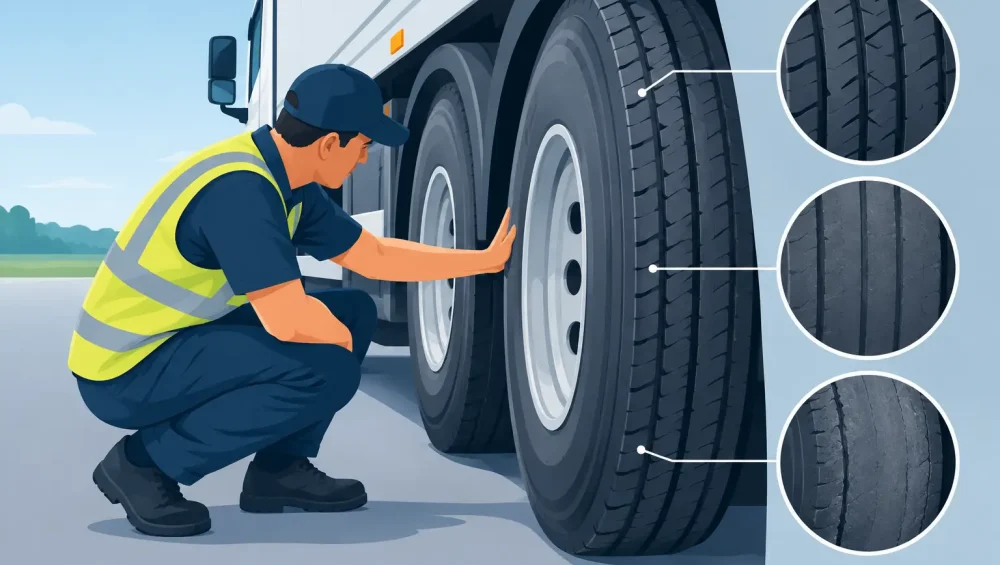
Check tyres when the vehicle is parked safely, unloaded where practical and the tyres are cool. Walk around the entire truck and trailer, looking at both the outer and inner shoulders. Inner-edge wear is easy to miss, especially on dual assemblies, but it can point to an alignment or suspension issue that needs attention.
Run your hand lightly across the tread in both directions. A healthy tyre should feel even. If it feels sharp in one direction and smooth in the other, known as feathering, do not ignore it. Take note of cuts, bulges, exposed cords, stones caught in the tread and any signs of rubbing against guards or suspension components.
Tread depth matters, but the pattern of wear often tells the more useful story. In Australia, heavy vehicle tyres must maintain at least 1.5 mm of tread depth across the required continuous band. Waiting until a tyre reaches the legal minimum is not a maintenance plan. Wet-road grip, heat control and casing protection can all suffer well before that point, particularly under a loaded trailer.
How to read truck tyre wear patterns
Wear in the centre of the tread
A tyre that is worn through the middle but has deeper tread on both shoulders is commonly overinflated for the load it is carrying. Too much pressure reduces the contact patch, so the centre takes more of the work. It can also make the ride harsher and increase the chance of impact damage on rough roads.
That said, do not simply let air out based on appearance alone. The correct pressure depends on the tyre size, axle load, application and manufacturer recommendation. A steer tyre, drive tyre and trailer tyre may all need different pressures. Check pressures with a reliable gauge and match them to the real working load.
Wear on both shoulders
When both outside edges are wearing faster than the centre, underinflation is often the cause. The tyre flexes more, builds excessive heat and works harder on the shoulders. On a heavy vehicle, that heat can quickly damage the casing and raise the risk of a failure.
Underinflation can happen slowly through normal air loss, a leaking valve, a damaged rim, a puncture or a pressure check that has been missed during a busy week. On dual wheels, a low tyre can force its mate to carry more load as well. That is why a pressure issue on one position should never be treated as a minor problem.
One shoulder worn more than the other
A tyre worn heavily on one side often points to wheel alignment, axle alignment, camber or suspension concerns. Steer tyres are the obvious place to look, but drive and trailer tyres can show the same warning where an axle is not tracking correctly.
If the inside shoulder is worn, there may be excessive negative camber or worn steering and suspension components. Outer shoulder wear can come from positive camber, hard cornering, overloaded operation or alignment settings that are out. The exact cause depends on the axle position and truck setup, so the right move is to inspect the vehicle rather than fitting a replacement tyre and hoping for the best.
Feathering or saw-tooth tread
Feathering feels like a series of small ramps across the tread blocks. It is commonly linked to incorrect toe settings, although loose steering parts, worn suspension bushes and wheel bearing issues can contribute. The tyre may still look acceptable from a distance, but a hand check will show the uneven pattern.
Feathered tyres can become noisy, lose grip and wear through faster than expected. If you catch it early, an alignment and component check may save the remaining tread. Leave it too long and the tyre may no longer be suitable for its position.
Cupping, scalloping or dips around the tyre
Cupping appears as repeated high and low patches around the tyre circumference. It is often associated with wheel imbalance, worn shock absorbers, damaged suspension components or bearing problems. On steer tyres, it can also come with steering vibration that the driver feels through the wheel.
This pattern needs prompt attention because replacing only the tyre may not fix the cause. A new tyre fitted to a worn suspension setup can develop the same damage surprisingly quickly. Have the wheel, balance, shocks, bearings and suspension checked together.
Irregular wear on drive tyres
Drive tyres can wear differently because they handle traction, torque and load transfer. Heel-and-toe wear, where one edge of a tread block is higher than the other, may be normal to a degree on certain lug patterns. Severe heel-and-toe wear, however, can be made worse by incorrect inflation, frequent stop-start work, heavy torque, poor rotation practices or worn suspension.
For tippers, earthmoving trucks and vehicles travelling in and out of job sites, cuts and chunking can also be a concern. Loose rock, sharp debris, wheel spin and unsuitable tyre choice all take a toll. A tyre designed for long-haul highway work will not always suit regular quarry or unsealed-road use. The application matters as much as the brand or purchase price.
Check dual tyres as a pair
Dual assemblies deserve extra attention. Both tyres should be closely matched in size and tread depth so they share the load properly. If one tyre has a significantly smaller rolling circumference, it can scrub, overheat and place extra stress on the other tyre.
Look for sidewall contact marks between the tyres, trapped stones and uneven pressure. A failed inner dual is not always obvious during a rushed walk-around, but it can overload the remaining tyre and lead to a much bigger roadside problem. Use a gauge, not a kick of the boot, to confirm pressures.
Match the fix to the cause
Tyre wear is evidence, not the diagnosis on its own. Replacing a badly worn tyre is necessary, but finding the cause is what prevents the replacement from wearing out early. Pressure-related wear needs proper inflation management. Alignment wear needs axle and steering geometry checked. Cupping may need balancing and suspension repairs. Damage from job-site conditions may require a tougher tyre pattern or a different operating approach.
Rotation can help extend tyre life where it suits the vehicle and tyre design, but it cannot correct a mechanical fault. Nor should tyres be moved between positions without considering load rating, tread pattern, casing condition and the manufacturer’s recommendations. Steer, drive and trailer positions all do different work.
Build tyre checks into every shift
The best inspections are brief and regular, not occasional marathon checks after a problem appears. Drivers should report vibration, pulling, steering changes, repeated pressure loss or unusual road noise as soon as they notice it. Fleet managers should record tread depth and pressure readings so a developing pattern is easy to spot across vehicles.
A mobile tyre service is particularly useful when the truck cannot afford to leave a depot, farm, work site or roadside location for a workshop visit. Hunter Mobile Truck Tyres provides on-site pressure checks, tyre repairs, replacements, fitting, balancing and fleet support across the Hunter region, helping operators deal with tyre issues before they turn into extended downtime.
If a tyre shows exposed cords, a bulge, deep sidewall damage, rapid air loss or severe irregular wear, park the vehicle safely and get it inspected. A few minutes spent reading the tread can be the difference between planned maintenance and a load stranded on the side of the road.